➡️ The Employee Net Promoter Score (eNPS) is a metric used to measure employees’ satisfaction with their job by assessing their willingness to recommend their company to others. McME helps organizations set up an accurate eNPS measurement. eNPS scores can range from:
eNPS scores can range from:
eNPS (Employee Net Promoter Score) is a metric developed at Harvard, originally intended to measure consumers’ engagement with brands.
Nowadays, eNPS is used to measure employees’ engagement with their employer. The basic idea is simple: organizations aim to have more promoters than detractors.
The greater the margin in favor of promoters, the more successful the organization will be. This is because promoters act as ambassadors who positively recommend the organization, leading to a stronger brand image and better business results. ⚖️

☝️ Did you know…
… eNPS is a powerful indicator of your organization’s growth and profitability?
eNPS is an extremely important indicator of an organization’s success.
Promoters contribute to a positive reputation and wide reach through electronic media.
eNPS combined with motivation questions offers a clear view of employees’ perceptions.
Identify the key drivers and take targeted actions to boost engagement.
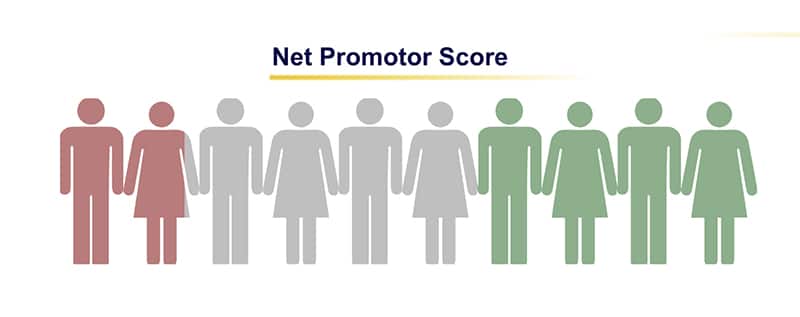
Employees rate their organization on a scale from 0 to 10.
The measurement of eNPS is done by sending out a survey in which employees indicate how likely they are to recommend the company. The eNPS score is calculated by subtracting the percentage of detractors from the percentage of promoters.
We investigate why promoters recommend your organization, what improvements passives want to become promoters, and why detractors discourage others from your organization.
By integrating eNPS into a comprehensive questionnaire, we use statistical analyses to uncover the drivers of engagement. This helps organizations know which “levers” to pull to gain more promoters and increase engagement.
The insights from eNPS lead to concrete actions that result in higher customer satisfaction, increased productivity, and loyal employees.

Based on a proven metric from Harvard.
Understand the reasons behind the scores of promoters, passives, and detractors.
Identify the key drivers and take targeted actions.
More promoters lead to a stronger organizational culture and better business results.
Save up to 30% with, among others, the SME Portfolio. Read more here.
Unlock your team’s potential with eNPS! Would you like to effectively measure and improve your employees’ satisfaction and loyalty? Our free whitepaper on eNPS provides you with in-depth insights and practical strategies to create a strong and engaged company culture.
🔍 What you can expect:

Why measure and track employee engagement, satisfaction and well-being over time?
Satisfied and motivated employees are more productive; they ensure greater customer satisfaction and contribute to a positive perception of their company on the job market. Objectifying the perceptions that employees hold about the organization in which they work not only uncovers the pain points but, above all, makes it imperative to take action.
Does a survey provide more and different information than the insights gathered through personal conversations, such as performance reviews or positions adopted by union representation?
Organizations and companies that limit themselves to personal conversations run the risk of gaining a distorted—and even overly negative—view of what truly exists among their current staff:
In a survey, every employee is given an equal voice and will be able to express themselves on all aspects of working life.
A systematic, structural survey of staff and personal conversations are, however, complementary: personal conversations provide deeper insight into the underlying issues and the ways in which they can be addressed.
What is the difference between a survey measuring employee engagement, satisfaction, and well-being and the so-called “Culture Barometer” or an “Employee Engagement Survey”?
The classic design of an employee survey is often focused on measuring the basic dimensions of staff satisfaction such as “Task,” “Compensation,” and “Working Conditions.”
More and more, organizations also want to measure dimensions such as the company’s style and employee engagement, and track them over time.
Ideally, all of these dimensions are included in a single survey so that the interrelationships and coherence among them can be studied.
Do SMEs also benefit from surveys such as the McMe survey on employee engagement, satisfaction, and well-being?
For large and medium-sized enterprises, the benefits are clear. The scale of the company often makes it impossible to keep a finger on the pulse through individual conversations.
In SMEs, conducting surveys through individual conversations would indeed be feasible. However, in practice we now see more and more SMEs moving toward systematic employee surveys. The anonymity of these surveys ensures that SME employees feel free to express their opinions openly and honestly—even on aspects such as leadership style and collegiality, which in a personal interview with the SME’s director can often trigger many sensitivities. It is precisely this relative small scale of many SMEs that means employees do not fully dare to voice their opinions when asked in one-on-one conversations. In this case, an anonymous and reliable form of data collection provides the solution.
How often are the McMe surveys conducted?
Generally, these surveys are conducted every two years. This allows enough time to implement improvement actions and monitor their effects. Organizations experiencing rapid growth or major change processes sometimes benefit from measuring at a faster pace; in such cases, surveys at shorter intervals are possible. And because it’s crucial to actually “do” something with the results of these studies, organizations with a large workforce often choose to phase their surveys—for example, surveying manual workers one year and salaried employees the next.

The employee survey clearly mapped where our teams were struggling. With McME’s insights and guidance, we adjusted our workflows and provided additional support. Thanks to the pulse checks, we now regularly follow up on the results.
Om de beste ervaringen te bieden, gebruiken wij en onze partners technologieën zoals cookies om informatie over het apparaat op te slaan en/of te openen. Toestemming voor deze technologieën stelt ons en onze partners in staat om persoonlijke gegevens zoals surfgedrag of unieke ID's op deze site te verwerken en om gepersonaliseerde en niet-gepersonaliseerde advertenties te tonen. Als u geen toestemming geeft of deze intrekt, kan dit invloed hebben op bepaalde functies.